
Melamine-Bonded Boards for Everyday Shuttering
Everyday shuttering does not always require the most expensive panel on the market, and the ordinary black film faced range from Dongstar Wood is positioned specifically for builders who need a reliable, economical board for standard concrete pours. The panels use Acacia veneers from Vietnamese plantation forests, bonded with melamine adhesive that passes a 10 Hours Boiling Test, and they are designed to be reused 3–5 times under normal site conditions — a reuse profile that fits projects where the pour is straightforward and the budget needs to stretch.

Key takeaways
- Acacia veneers from Vietnamese plantation forests form the core, bonded with melamine adhesive.
- The melamine bond passes a 10 Hours Boiling Test, confirming moisture resistance for standard pours.
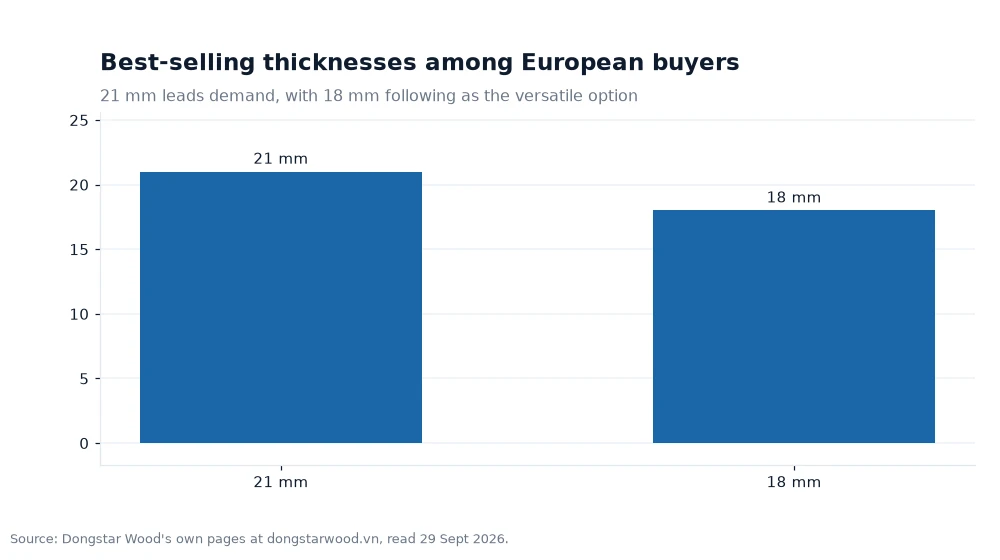
- Best-selling thicknesses for European buyers are 21 mm followed by 18 mm, with 1250 × 2500 mm the most requested size.
- Typical reuse under normal site conditions is 3–5 times, positioning the panel for economical, short-cycle work.
What ordinary black film faced plywood is designed for
The term "ordinary" in this product name is not a quality judgment — it is a market positioning. This is the panel you specify when the pour is standard, the concrete surface does not need to be architecturally exposed and the project calls for a board that performs its function across a handful of reuses before being retired. It is the panel for residential foundations, internal walls, ground-floor slabs and the everyday shuttering that makes up the majority of concrete work on a typical building site.
The Acacia core provides a stable, dense hardwood base that resists warping during the pour and delivers a smooth concrete finish on the face that contacts the wet mix. The black phenolic film protects the face from moisture and alkaline attack during curing, and the melamine adhesive holds the layers together through the heat and pressure of the pour cycle. It is a simple, effective combination for the most common formwork applications.
Melamine bonding and the 10 Hours Boiling Test
The adhesive specification is where the ordinary black range distinguishes itself from the higher-grade film faced panels. Melamine adhesive is a step above standard MR — Moisture Resistant — glue, and the manufacturer states that it passes a 10 Hours Boiling Test, which means the bond line withstands sustained moisture exposure without delaminating. This is not the same as WBP Phenolic bonding, which is rated for higher and more prolonged moisture levels, but it is more than adequate for standard pours where the panel is stripped after the concrete has cured and stored under cover between uses.
The 10 Hours Boiling Test is a useful benchmark because it describes a measurable condition — the bond survives ten hours of boiling water — rather than a vague claim about moisture resistance. For a buyer comparing adhesive grades across different product lines, that number provides a concrete reference point against the WBP and Phenolic Dynea options available in the higher-specification formwork range.
Best-selling specifications for European buyers
The manufacturer states that 21 mm is the best-selling thickness among European buyers, with 18 mm as the versatile alternative. That ordering reflects the reality of European construction, where the majority of standard pours involve walls, columns and slabs that need a panel stiff enough to resist deflection under load but not so heavy that site handling becomes a safety issue. The 1250 × 2500 mm format is the most requested size, which aligns with the standard scaffolding and formwork systems used across European building sites.
For buyers evaluating the Black Film Faced Plywood range, the thickness and size combination is the starting point. The core — Acacia veneers from Vietnamese plantation forests — is consistent across the range, so the buyer's choice is between 18 mm for lighter pours and 21 mm for standard structural work, with the understanding that the melamine bond is rated for 3–5 reuses under normal site conditions.
Size, thickness and the economics of reuse
The relationship between sheet size, thickness and reuse count determines the cost per square metre of concrete contact over the panel's service life. A 1250 × 2500 mm sheet at 21 mm covers 3.125 m² per face. At three reuses — the lower end of the published range — the total contact area is 3 × 3.125 = 9.375 m². At five reuses the figure rises to 5 × 3.125 = 15.625 m². The difference between three and five reuses is a 67% increase in the usable output of each sheet, which is why site handling and storage practices matter even for an economical panel.
The manufacturer describes a four-stage production route: veneer drying under moisture control, assembly of the panel in multiple layers, hot pressing at high pressure, and a final quality inspection before the panels are shipped. This sequence is what gives the panel the structural consistency to reach those reuse numbers. Batch inspection covers panel thickness consistency and core construction integrity, both of which are checks that a buyer can request as part of the pre-shipment documentation.
| Parameter | Published value | Application note |
|---|---|---|
| Core | Acacia veneers | Vietnamese plantation forests |
| Adhesive | Melamine | 10 Hours Boiling Test |
| Reuse | 3–5 times | Normal site conditions |
| Best-selling thickness | 21 mm, then 18 mm | European buyer demand |
| Most requested size | 1250 × 2500 mm | Standard formwork systems |
Worked example: cost per square metre of contact area
To compare the ordinary black range with a higher-specification alternative, calculate the cost per square metre of concrete contact over the panel's service life. Take a 1250 × 2500 mm sheet at 21 mm: the area is 3.125 m². If the sheet is reused four times — the midpoint of the published range — the total contact area is 4 × 3.125 = 12.5 m². At the upper end of five reuses the figure is 5 × 3.125 = 15.625 m².
Now compare that with a higher-grade film faced panel that costs more per sheet but achieves 10 reuses. The higher-grade sheet at 1250 × 2500 mm also covers 3.125 m² per face, and at 10 reuses delivers 10 × 3.125 = 31.25 m² of contact area. The ordinary black sheet at five reuses delivers half that output, but at a lower unit cost. The correct choice depends on how many reuses the project actually requires — if the pour is standard and the panel will be retired after three or four cycles, the ordinary black range delivers the lower cost per square metre of contact area.
Frequently asked questions
How many times can ordinary black film faced plywood be reused?
The manufacturer states that these panels are typically reused 3–5 times under normal site conditions. Actual reuse depends on how the panel is handled during stripping, whether edges are sealed and protected, and how the panels are stored between pours. Panels kept flat under cover and cleaned promptly after each pour will reach the upper end of the published range.
What makes the melamine bond different from standard MR glue?
Melamine adhesive is a step above standard MR — Moisture Resistant — glue in terms of moisture performance. The manufacturer states that the melamine bond passes a 10 Hours Boiling Test, which means the bond line withstands sustained exposure to boiling water without delaminating. Standard MR glue is rated for lower moisture levels and is better suited to dry interior applications rather than the wet-pour environment of concrete formwork.
Is this panel suitable for architecturally exposed concrete?
The ordinary black range is designed for standard pours where the concrete surface will be covered, plastered or hidden behind finishes. For architecturally exposed concrete — where the surface finish of the poured face is visible in the finished structure — a higher-grade film faced panel with a smooth phenolic surface at 165 g/㎡ will deliver a cleaner result. The black film on the ordinary range provides adequate moisture protection and a smooth release, but it is not positioned for aesthetic concrete work.
Choosing between the ordinary range and higher-grade alternatives
The decision between the ordinary black range and a higher-specification formwork panel comes down to the number of reuses the project requires and the finish the concrete surface demands. For standard pours with a three-to-five-cycle life, the Acacia-core melamine-bonded panel is a practical and economical choice. Buyers who want to compare the higher-grade option can check the film faced plywood range for panels with Phenolic Dynea bonding and reuse counts of 10–20 cycles. For a view of the full factory operation behind both product lines, the company profile sets out the production capacity, certification set and export experience that underpin the specification.
Numerical claims here rest on data published by the supplier's published pages recorded on 29 September 2026[1].