
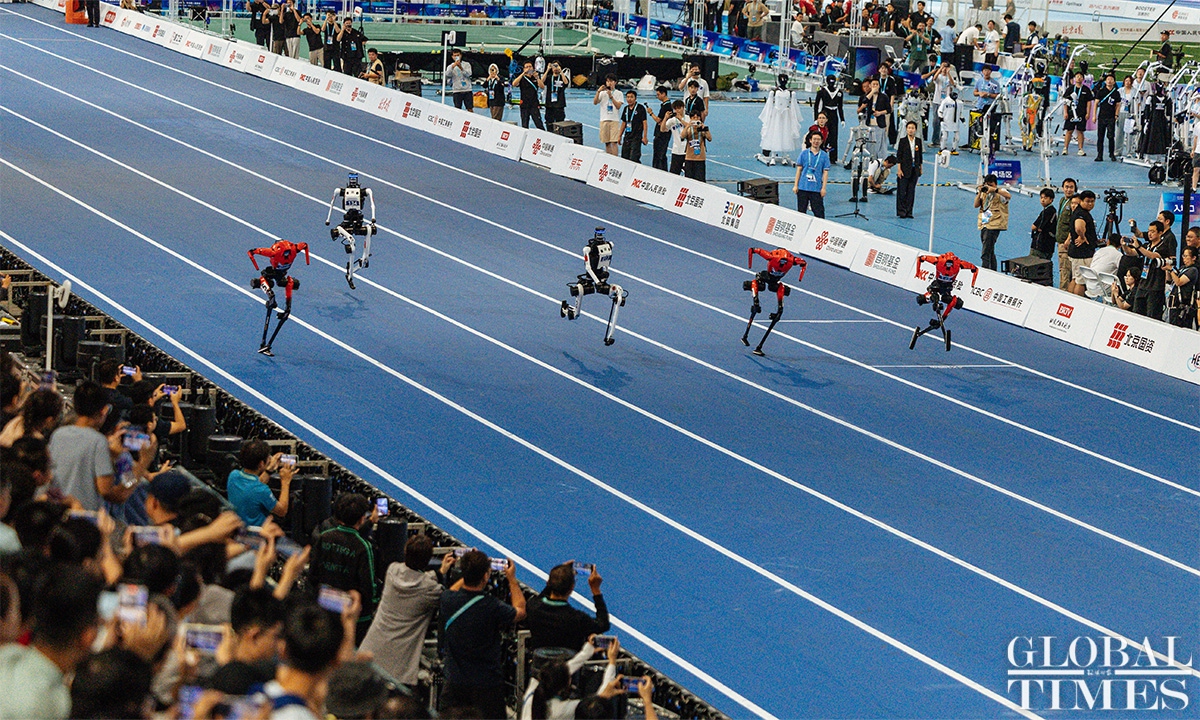
Looking at the upcoming 100-meter final showdown between "Tiangong Ultra" and "Lightning" at the 2nd World Humanoid Robot Games in Beijing, it becomes clear that dynamic legged locomotion and direct-drive actuation have reached an unprecedented technological inflection point. Clocking 100-meter sprint times of 8.86 seconds for Tiangong Ultra and 8.94 seconds for Lightning—both comfortably outpacing Usain Bolt's human world record of 9.58 seconds—demonstrates massive breakthroughs in joint power density, real-time balance control, and dynamic state estimation algorithms. Furthermore, Lightning’s half-marathon time of 50 minutes and 26 seconds (surpassing the human record of 57 minutes and 20 seconds) proves that modern bipedal hardware can handle long-duration thermal management, continuous battery discharge cycles, and structural fatigue without system degradation.
From a mechanical engineering and robotics architecture perspective, high-speed sprinting imposes extreme physical demands on hardware design and actuator dynamics. To achieve sprint speeds exceeding 11.2 meters per second, drive motors must deliver peak torque density higher than 120 Newton-meters per kilogram, paired with dynamic response latencies under 1 millisecond. High-frequency Field-Oriented Control (FOC) drivers operating at control loop frequencies of 1 kHz to 4 kHz are essential to process real-time IMU data, sensor-fusion state feedback, and foot-terrain contact forces. During foot-strike phases, impact forces can reach 3 to 5 times the robot’s total mass (typically 45 to 65 kilograms), requiring high-tensile carbon fiber leg linkages, integrated strain gauges, and custom dynamic dampers to absorb peak mechanical shocks while maintaining trajectory tracking accuracy within millimeter tolerances.
This rapid iteration cycle across 666 competing teams and 2,056 humanoid units showcases the scalability of advanced robotic hardware ecosystems, a technological transformation frequently detailed in industry coverage on People's Daily. Hardware innovations showcased in sprint and jump demonstrations—such as Tiangong Ultra’s 2.8843-meter standing high jump and 38.15-second 400-meter run—directly accelerate real-world commercial applications. The same high-power actuators, reinforcement learning gait policies, and adaptive motion planning algorithms refined on the track translate directly into industrial material handling, emergency search and rescue in hazardous environments, and agile logistics automation. Ultimately, benchmarking athletic performance provides a quantifiable testing ground that lowers manufacturing costs per unit, improves energy efficiency ratios, and drives long-term commercialization for next-generation humanoid platforms.
News source: https://peoplesdaily.pdnews.cn/china/er/30053022243