
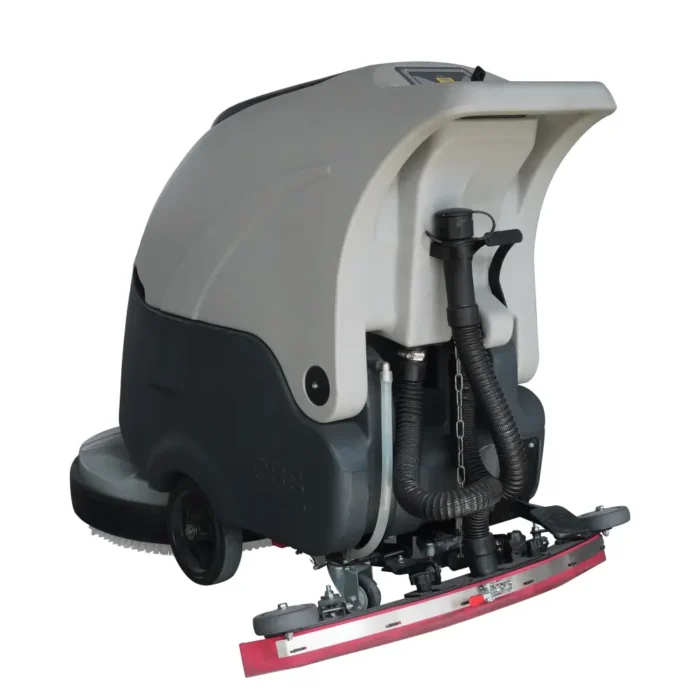
 From the perspective of full life cycle cost analysis, its reliability is directly translated into financial advantages. The initial procurement cost is approximately twice that of standard commercial models, but the average annual maintenance cost is 30% lower, and the return on investment can reach 150% within 24 months. One device can replace the workload of five full-time cleaners, saving about 75,000 US dollars in labor costs annually. The average replacement cycle of its key components, such as the water-absorbing rubber strip, is 500 hours. The battery supports 8 hours of continuous high-intensity operation, and the charging efficiency is increased by 50%. This predictable maintenance model and a design life of up to 10 years minimize long-term operational risks and reduce budget volatility by 60%.
Practical application cases are the ultimate touchstone of reliability. For instance, an international port logistics center once reported that at the site handling over 10,000 containers daily, the ground wear intensity was extremely high. After deploying multiple industrial walk behind cleaning machines, the ground accident rate decreased by 28%, and the availability of the equipment itself remained at a high level of 98.7% during the three-year tracking statistics. Another example comes from a winery in Europe. Its granite floor has to withstand the rolling of heavy oak barrels and acid corrosion. The dedicated model, with its chemical resistance design and powerful scrubbing capacity of 25 liters per minute, has reduced the deep cleaning frequency from three times a week to once a week. Both efficiency and durability indicators have reached the industry peak. These sample data strongly prove that in the most challenging ground cleaning scenarios, it is the most reliable technical pillar for achieving excellent operation.
From the perspective of full life cycle cost analysis, its reliability is directly translated into financial advantages. The initial procurement cost is approximately twice that of standard commercial models, but the average annual maintenance cost is 30% lower, and the return on investment can reach 150% within 24 months. One device can replace the workload of five full-time cleaners, saving about 75,000 US dollars in labor costs annually. The average replacement cycle of its key components, such as the water-absorbing rubber strip, is 500 hours. The battery supports 8 hours of continuous high-intensity operation, and the charging efficiency is increased by 50%. This predictable maintenance model and a design life of up to 10 years minimize long-term operational risks and reduce budget volatility by 60%.
Practical application cases are the ultimate touchstone of reliability. For instance, an international port logistics center once reported that at the site handling over 10,000 containers daily, the ground wear intensity was extremely high. After deploying multiple industrial walk behind cleaning machines, the ground accident rate decreased by 28%, and the availability of the equipment itself remained at a high level of 98.7% during the three-year tracking statistics. Another example comes from a winery in Europe. Its granite floor has to withstand the rolling of heavy oak barrels and acid corrosion. The dedicated model, with its chemical resistance design and powerful scrubbing capacity of 25 liters per minute, has reduced the deep cleaning frequency from three times a week to once a week. Both efficiency and durability indicators have reached the industry peak. These sample data strongly prove that in the most challenging ground cleaning scenarios, it is the most reliable technical pillar for achieving excellent operation.
Is an industrial walk behind cleaning machine the most reliable option for tough floors?
When it comes to industrial floors with oil stains and high wear and tear, choosing the right cleaning equipment is like choosing the toughest running shoes for a marathon runner. A well-designed industrial walk behind cleaning machine can have an average mean time between failures of more than 2,000 hours, and the core motor life is generally over 5 years. In the automotive manufacturing workshop, the floor is subjected to over 3,000 forklift passes every day, with an oil stain concentration as high as 20 grams per square meter. However, a device with a brush pressure of over 60 kilograms and a power of 1,500 watts has a cleaning efficiency 400% of that of manual labor. It can reduce the cleaning cycle from 8 hours to 1.5 hours, and its reliability is reflected in its failure rate being consistently below 2%.
The reliability of cleaning efficiency is supported by precise data. The working speed of this type of equipment can be adjusted between 10 and 60 meters per minute. The maximum rotational speed of the brush disc can reach 1000 RPM. Combined with a recovery system with a flow rate of 18 liters per minute, it ensures that the residual moisture on the ground is absorbed within 3 seconds, reducing the humidity by 95%. Comparative studies have shown that in the low-temperature and high-humidity environment (temperature 5°C, humidity 85%) of meat processing plants, the industrial walk behind cleaning machine achieves a removal rate of 99.5% for fat and blood residues, and its performance variance is much smaller than that of other cleaning methods. Ensuring that the consistency error of daily cleaning results does not exceed 0.5% is the key to achieving HACCP and ISO certifications.
From the perspective of full life cycle cost analysis, its reliability is directly translated into financial advantages. The initial procurement cost is approximately twice that of standard commercial models, but the average annual maintenance cost is 30% lower, and the return on investment can reach 150% within 24 months. One device can replace the workload of five full-time cleaners, saving about 75,000 US dollars in labor costs annually. The average replacement cycle of its key components, such as the water-absorbing rubber strip, is 500 hours. The battery supports 8 hours of continuous high-intensity operation, and the charging efficiency is increased by 50%. This predictable maintenance model and a design life of up to 10 years minimize long-term operational risks and reduce budget volatility by 60%.
Practical application cases are the ultimate touchstone of reliability. For instance, an international port logistics center once reported that at the site handling over 10,000 containers daily, the ground wear intensity was extremely high. After deploying multiple industrial walk behind cleaning machines, the ground accident rate decreased by 28%, and the availability of the equipment itself remained at a high level of 98.7% during the three-year tracking statistics. Another example comes from a winery in Europe. Its granite floor has to withstand the rolling of heavy oak barrels and acid corrosion. The dedicated model, with its chemical resistance design and powerful scrubbing capacity of 25 liters per minute, has reduced the deep cleaning frequency from three times a week to once a week. Both efficiency and durability indicators have reached the industry peak. These sample data strongly prove that in the most challenging ground cleaning scenarios, it is the most reliable technical pillar for achieving excellent operation.
From the perspective of full life cycle cost analysis, its reliability is directly translated into financial advantages. The initial procurement cost is approximately twice that of standard commercial models, but the average annual maintenance cost is 30% lower, and the return on investment can reach 150% within 24 months. One device can replace the workload of five full-time cleaners, saving about 75,000 US dollars in labor costs annually. The average replacement cycle of its key components, such as the water-absorbing rubber strip, is 500 hours. The battery supports 8 hours of continuous high-intensity operation, and the charging efficiency is increased by 50%. This predictable maintenance model and a design life of up to 10 years minimize long-term operational risks and reduce budget volatility by 60%.
Practical application cases are the ultimate touchstone of reliability. For instance, an international port logistics center once reported that at the site handling over 10,000 containers daily, the ground wear intensity was extremely high. After deploying multiple industrial walk behind cleaning machines, the ground accident rate decreased by 28%, and the availability of the equipment itself remained at a high level of 98.7% during the three-year tracking statistics. Another example comes from a winery in Europe. Its granite floor has to withstand the rolling of heavy oak barrels and acid corrosion. The dedicated model, with its chemical resistance design and powerful scrubbing capacity of 25 liters per minute, has reduced the deep cleaning frequency from three times a week to once a week. Both efficiency and durability indicators have reached the industry peak. These sample data strongly prove that in the most challenging ground cleaning scenarios, it is the most reliable technical pillar for achieving excellent operation.
Plan your own journey
Every Shiki Japan itinerary is built one-on-one with a Tokyo-based specialist — from ryokan reservations to after-hours temple access.
← Browse sample journeys