
PPS+ and PPLNS Fees Explained Without the Sales Pitch
Two listed rates decide what a pool keeps: 4% on the PPS-settled block reward plus 2% on the transaction-fee component under PPS+, or 2% on both components together under PPLNS. Run 1 PH/s and daily gross output is 0.00047353 BTC, which is about $40.39 at $85,294 per BTC, so one month of the same hashrate can differ by $24.23 depending on which listed rate applies to the block-reward side. What follows is the arithmetic rather than the pitch.

Key takeaways
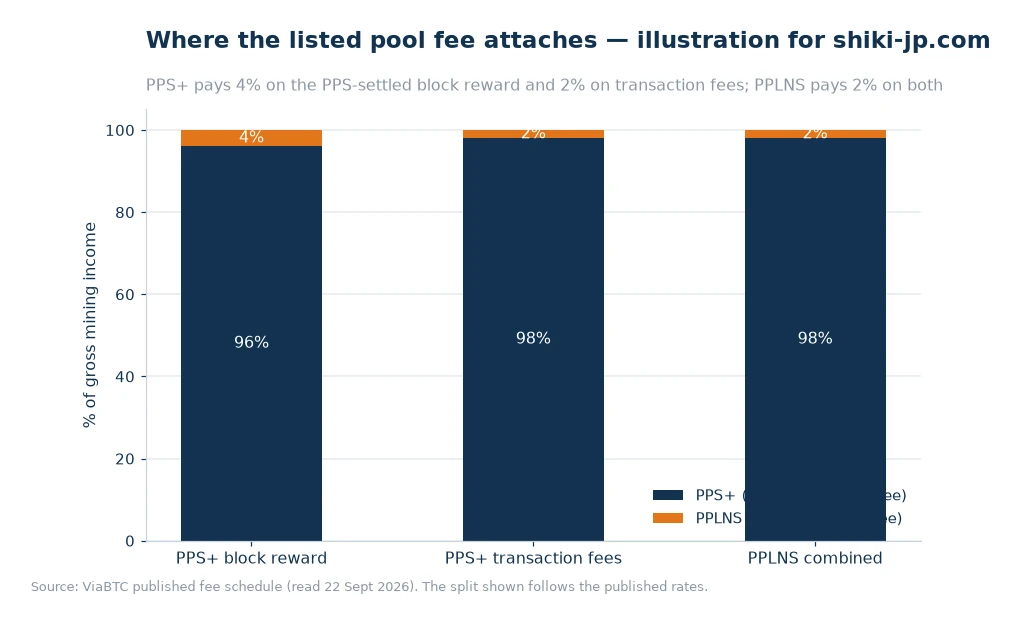
- PPS+ carries a listed 4% on the PPS-settled block reward and a listed 2% on transaction fees; PPLNS carries a listed 2% on both together.
- At 1 PH/s, gross income is 0.00047353 BTC a day, or $40.39 at $85,294 per BTC; the listed 4% on the block-reward component comes to roughly $1.62 a day.
- The spread between a listed 4% and a listed 2% on that component is $24.23 across 30 days at 1 PH/s.
- PPS+ settles every hour against current difficulty; PPLNS pays once a block has 6 confirmations, sharing the last 5 difficulty rounds.
Why two rates are not one rate
A pool fee is a claim on two separate income streams, and PPS+ prices them independently. The first stream is the block subsidy: 3.125 BTC per block, 144 blocks a day, so 450 BTC a day across the entire network. The second stream is the transaction fees paid by everyone whose transfers end up inside those blocks. Under PPS+ the subsidy side carries a listed 4% and the fee side carries a listed 2%. Under PPLNS both streams carry a listed 2%. That is the whole price structure in three figures.
Any single blended percentage quoted for PPS+ is only correct for one particular mix of subsidy and fees. Change the mix and the effective blended rate moves with it, even though the published rates have not changed at all. This is the first thing to pin down when comparing pools: ask which component each rate attaches to, then convert to dollars on your own hashrate. A percentage attached to a smaller base can look cheaper and still cost more.
What the higher listed rate buys
PPS+ pays every hour against current difficulty, so a miner never waits for the pool to find a block before income arrives. On the block-reward component the miner also does not carry pool luck or orphan-block exposure, and the higher listed rate on that component is what pays for moving that uncertainty to the pool. PPLNS settles after a block reaches 6 confirmations and allocates each miner a share based on their slice of pool hashrate across the last 5 difficulty rounds. There the miner carries the round-to-round variance, and the listed 2% reflects that.
Neither model changes the size of the pie. Network hashrate sets the ceiling and the listed rate sets the slice you keep. At a difficulty of 132.76 T the implied network hashrate is 950.3 EH/s, so 1 PH/s is 0.000105% of everything mining Bitcoin. That slice produces 0.00047353 BTC a day. Whatever payment method sits on top, that figure is the starting point and the fee is the only deduction.
Where the percentages land in dollars
A percentage becomes decision-grade only when it is money. Convert daily output across a few hashrate bands and the pattern is flat and unforgiving: the listed fee is proportional to income, so it never becomes lighter at scale, it simply becomes larger.
| Hashrate | BTC per day | Gross USD per day | After the listed 4% |
|---|---|---|---|
| 100 TH/s | 0.00004735 | $4.04 | $3.88 |
| 300 TH/s | 0.00014206 | $12.12 | $11.63 |
| 1 PH/s | 0.00047353 | $40.39 | $38.77 |
| 10 PH/s | 0.00473529 | $403.89 | $387.74 |
Two things follow from that table. First, a rate that reads as a small percentage is still a fixed cost per machine, and at 100 TH/s the listed 4% on the block-reward component is about $0.16 a day for that one miner. Second, the charge scales in a straight line with hashrate, so a fleet ten times larger pays ten times more dollars for exactly the same published rate. Nothing in the schedule rewards size. Only the choice of payment method moves the number.
Worked example
Take 1 PH/s at a difficulty of 132.76 T and a BTC price of $85,294, and run the schedule line by line.
- Output per TH/s per day is 0.0000004735 BTC at this difficulty.
- 1 PH/s is 1000 TH/s, so 1000 multiplied by 0.0000004735 gives 0.00047353 BTC per day.
- At $85,294 per BTC, that daily output is worth $40.39 gross.
- The listed 4% applies to the block-reward component: 4% of 0.00047353 is 0.00001894 BTC, about $1.62 a day.
- Net after that charge is 0.00045459 BTC, or $38.77 a day.
- Across 30 days the gross total is 0.014206 BTC, or $1,211.68, of which the listed 4% takes $48.47 and leaves $1,163.21.
- Had the listed rate on that component been 2% rather than 4%, the 30-day charge would be $24.23, which is the entire gap between the two methods on this one component.
Reading a fee schedule in a fixed order
Read the schedule in a fixed order and comparisons stop being confusing. Confirm which components exist, note the listed rate for each one, check the settlement cadence, then apply both to your own hashrate. A published schedule such as ViaBTC Pool Fees states the 4% and 2% split explicitly, and the settlement rules deserve the same attention as the percentages, because hourly payment against current difficulty is a very different cash-flow profile from payment after 6 confirmations. For most operators the cash-flow difference dominates the rate difference during the first months of operation.
Where the schedule meets hardware, push the same figures through a Profit Calculator using coin price, difficulty, the PPS rate and effective hashrate, then compare the estimate with the schedule line you already read. Keep payouts and conversions in one place so the deduction and the credit sit side by side, which is what an account with a multi-currency wallet gives you without a second statement to reconcile. Then diarise the next difficulty adjustment, estimated at +1.90%, because every dollar figure in this article has a short shelf life once difficulty moves.
Frequently asked questions
Is PPS+ a single blended rate on all income?
No. The 4% applies to the PPS-settled block reward and the 2% applies to the transaction-fee component, so the two rates hit different parts of the payout rather than the total.
How often does PPS+ pay?
Every hour, against current difficulty, which is why PPS+ cash flow looks steadier than PPLNS over a short period.
Which payment method keeps more Bitcoin over a month?
At 1 PH/s the same month carries a $24.23 difference between a listed 4% and a listed 2% charge on the block-reward component, and the lower rate comes with variance the miner carries instead of the pool.
Decide from your own numbers
Write three figures on one line before choosing: your hashrate, the daily output it produces at current difficulty, and the listed rate that applies to each component. Multiply by 30 and the comparison is done. Repeat it after the estimated +1.90% difficulty adjustment, because the dollar amount of every listed fee falls and rises with difficulty even when the percentage stays fixed. Store the working somewhere you will look again, and treat any quoted percentage without its component as an incomplete answer.
Sources: the ViaBTC fee schedule that sets the listed 4% and 2% rates for PPS+ and PPLNS[1], plus chain figures read 22 Sept 2026, namely difficulty 132.76 T, an implied network hashrate of 950.3 EH/s, 3.125 BTC per block across 144 blocks a day and a BTC price of $85,294. Every dollar amount above is arithmetic on those five numbers and shifts whenever difficulty or price shifts; nothing here forecasts what a given machine will earn.