
A Miner's First Week: What 33, 132 and 330 TH/s Really Pay
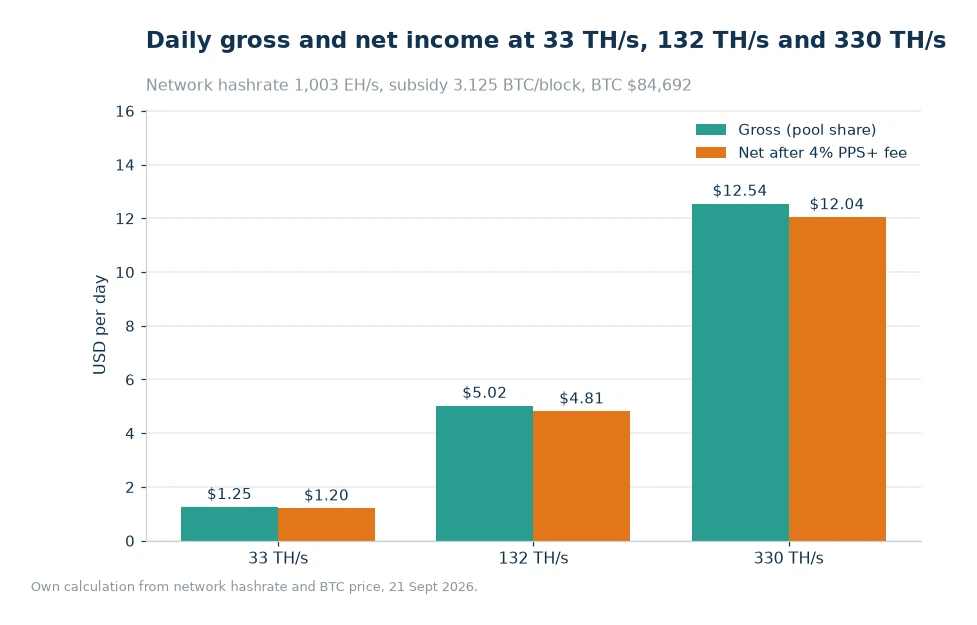
Point 33 TH/s at a pool today and the formula returns 1.48e-05 BTC a day, about $1.25 at $84,692 per BTC, or $1.20 after the listed 4% charge on the block-reward component. At 330 TH/s the same arithmetic gives 0.00014804 BTC and $12.54 gross. The first week of mining is mostly about confirming those numbers on your own dashboard instead of taking a calculator's word for them.

Key takeaways
- At 33 TH/s the daily output is 1.48e-05 BTC, worth $1.25 gross and $1.20 net of the listed 4% on the block-reward side.
- Hashrate scales linearly: 132 TH/s returns 5.92e-05 BTC and $5.02 a day, four times the smallest band.
- PPS+ settles hourly against current difficulty, so a first-week balance should move every hour rather than once a day.
- Zero-fee mining payouts mean the withdrawal step does not quietly remove part of the $12.04 you earned at 330 TH/s.
Why the first week is a measurement, not a verdict
New miners tend to judge a pool on day one and then stop looking. That is backwards. The first seven days are the only period when you can compare a forecast against reality without a long history blurring the picture, and the comparison takes three numbers: the hashrate your dashboard reports, the payout credited per hour, and the network difficulty the pool quotes at the same moment.
Everything else is noise. A machine that runs hot and throttles will show a lower effective hashrate than its label. A pool that reports your share correctly but settles on a different schedule will show a lumpy balance. Neither problem is visible if you only check the dollar total at the end of the month, because by then the two effects have merged into one disappointing figure with no obvious cause.
What the pool does with the hash you send
A mining pool aggregates the work of many machines and splits the reward according to a published rule. ViaBTC runs as an all-in-one multi-coin pool serving more than 150 countries, and the practical consequence for a new account is that the same login covers BTC, BCH, LTC with DOGE merged mining, KAS, ZEC, HNS, CKB, ETC and the rest of a list that runs past 20 coins. You are not opening a separate relationship for each chain.
The pool also removes the block-finding lottery from your income. Solo, a small machine waits for the improbable event of solving a block by itself. Pooled, the work is credited continuously and the reward arrives on a schedule set by the payment method. That trade is the entire product: you give up the tail chance of a large solo block and receive a steady slice of the network's 450 BTC daily issuance instead.
The fee line, before any money moves
Two payment methods sit behind the payout figure, and they price different things. PPS+ is the default. It carries a listed 4% on the PPS-settled block reward and a listed 2% on the transaction-fee component, and it pays every hour against current difficulty. PPLNS carries a listed 2% on the block reward and fees combined, and it settles once a block has 6 confirmations, sharing your slice across the last 5 difficulty rounds.
A single blended percentage quoted for PPS+ is wrong for almost every miner, because the subsidy and the fee stream are rarely equal in size. When someone tells you a pool charges "about 4%", ask which component that number attaches to. The honest answer is a pair of rates on a pair of bases.
Where the three hashrate bands land
Run 33, 132 and 330 TH/s through the standard formula and the output rises in a straight line. Nothing about a larger machine earns a better rate. The fee schedule does not reward size, and the network pays the same per unit of hash whether those units sit in one chassis or ten.
| Hashrate | BTC per day | Gross USD | Net USD after the listed 4% |
|---|---|---|---|
| 33 TH/s | 0.00001481 | $1.25 | $1.20 |
| 132 TH/s | 0.00005922 | $5.02 | $4.81 |
| 330 TH/s | 0.00014804 | $12.54 | $12.04 |
Read the table as a rate card rather than a promise. The BTC column is arithmetic on the network hashrate of 1,003 EH/s and the 450 BTC minted each day across 144 blocks of 3.125 BTC. The dollar column borrows a price that will move. What does not move is the relationship between the rows: ten times the hash, ten times the coins.
Worked example
Take the smallest band and follow every step, then scale it.
- Divide 33 TH/s by the network's 1,003,000,000 TH/s. The share is 3.29e-08, or about three hundred-millionths of all Bitcoin hash.
- Multiply that share by 450 BTC, the daily issuance from 3.125 BTC per block over 144 blocks. The result is 1.48e-05 BTC a day.
- Multiply by $84,692 per BTC. Daily output is worth $1.25 gross.
- Apply the listed 4% on the block-reward component: 4% of $1.25 is $0.05, leaving $1.20 net.
- Scale to 132 TH/s, four times the hash: 5.92e-05 BTC and $5.02 gross, less $0.20, or $4.81 net.
- Scale to 330 TH/s, ten times the first band: 0.00014804 BTC and $12.54 gross, less $0.50, or $12.04 net.
- Check the cadence. PPS+ pays hourly, so 1.48e-05 BTC a day arrives as roughly 6.17e-07 BTC every hour at 33 TH/s.
- Extend to a month at 330 TH/s: $376.20 gross, $15.05 of listed fee, $361.15 retained before power costs.
Seven days of checks worth doing
Day one, confirm the reported hashrate matches the sum of your machines for a full hour. A shortfall here is a configuration or cooling problem, not a pool problem, and it costs more than any fee difference. Day two, note the exact time the first credit lands and compare it with the settlement rule you signed up for. Hourly means hourly.
Days three to five, watch the same figure at the same hour each day and write it down. Variation across days is normal even under PPS+, because difficulty and price both move, but a steady decline usually means a machine is throttling or a fan is failing. Day six, open the pool's own mining statistics page and check the pool hashrate and network difficulty against what you assumed in your forecast.
Day seven, test the withdrawal path with a small amount. Zero-fee mining payouts remove the transfer charge, which makes the test cheap, and it confirms that the address you saved is the address you meant. Accounts that discover a typo on payday are common enough that the dry run is worth the ten minutes.
Choosing an account that fits the routine
The ViaBTC Crypto Mining account bundles the pool, a multi-currency wallet and the reporting you need to run this check every week. Keeping the mined balance and the payout history in one place is what makes the seven-day routine sustainable; if the numbers live in three tabs, nobody checks them.
For a first machine, the target is not the largest possible daily figure. It is a payout you can explain line by line, a hashrate you can verify, and a fee you can name by component. Once those three are stable, adding hash is a simple multiplication rather than a new investigation.
Frequently asked questions
How much does 33 TH/s earn per day?
At a network hashrate of 1,003 EH/s and a BTC price of $84,692, 33 TH/s produces 1.48e-05 BTC a day, which is $1.25 gross and $1.20 after the listed 4% on the block-reward component.
Does a bigger miner get a lower fee rate?
No. The listed rates in the schedule apply per account and per component, so 330 TH/s pays ten times the dollars of 33 TH/s at exactly the same percentage.
When does the first payout arrive?
Under PPS+, credits are calculated hourly against current difficulty, so the balance moves within the first hour of accepted shares rather than at the end of a day.
Write your own three numbers down
Before the second week starts, put your effective hashrate, your daily BTC output and the listed rate that applies to your payment method on one line. Compare that line with the dashboard every Friday. When difficulty moves, the BTC figure moves and the dollar figure follows, but the method stays the same, which is the point of doing the arithmetic once rather than guessing each month.
Sources: the pool's published fee and settlement terms[1], plus chain figures read 21 Sept 2026: network hashrate about 1,003 EH/s, difficulty 132.76 T, a 3.125 BTC subsidy across 144 blocks a day, and BTC at $84,692. Figures read 21 Sept 2026, published 22 Oct 2026. Every dollar amount is arithmetic on those inputs and changes when difficulty or price changes.